

It All Started with a Teary Parent-Teacher Meeting
I still remember the look on Meera’s face during our parent-teacher meeting last year. Her daughter, Anika, had just turned four and was in our Montessori environment for a few months. Meera leaned in with a worried voice and said, “She still can’t recite the alphabet. All the other kids in my apartment can say A to Z backward!”
She wasn’t angry. She wasn’t blaming anyone. She was simply scared. And I understood. We live in a world where tiny milestones are often treated like race checkpoints. But what Meera didn’t realize—like so many parents—is that learning isn’t a race. It’s a rhythm. And every child dances to their own beat.
The Truth About Developmental Readiness
Children don’t bloom on our schedules. They bloom on theirs.
Some start speaking in full sentences before they turn two. Some take their time until three or four. Some show interest in letters and numbers early, while others are more focused on climbing furniture and building castles out of blocks.
In Montessori, we have a deep-rooted belief: follow the child. That means we don’t push learning before the child is ready—we prepare the environment and patiently observe. When they’re ready, the learning flows naturally.
Imagine trying to teach a child to ride a bicycle before they’ve learned to balance—it would only lead to frustration. It’s the same with reading and writing. Before a child can comfortably grasp the alphabet, they need interest, readiness, and confidence.
What’s Really Happening When They “Play”
Let’s peek into what Anika was doing instead of memorizing the alphabet.
She spent time pouring water between jugs, carefully building towers, dressing herself, and arranging shapes by size and color. To an outsider, this might look like just play. But to a trained eye, this is concentration, coordination, motor development, and independence in the making.
All of these are foundational skills. These are what prepare a child’s brain and body for literacy later on. When you nurture these first, everything else—including the alphabet—follows more smoothly.
What You Can Do (Instead of Stressing)
If you’re a parent wondering how to help at home, here are a few gentle, joyful ways to encourage pre-literacy—without pressure:
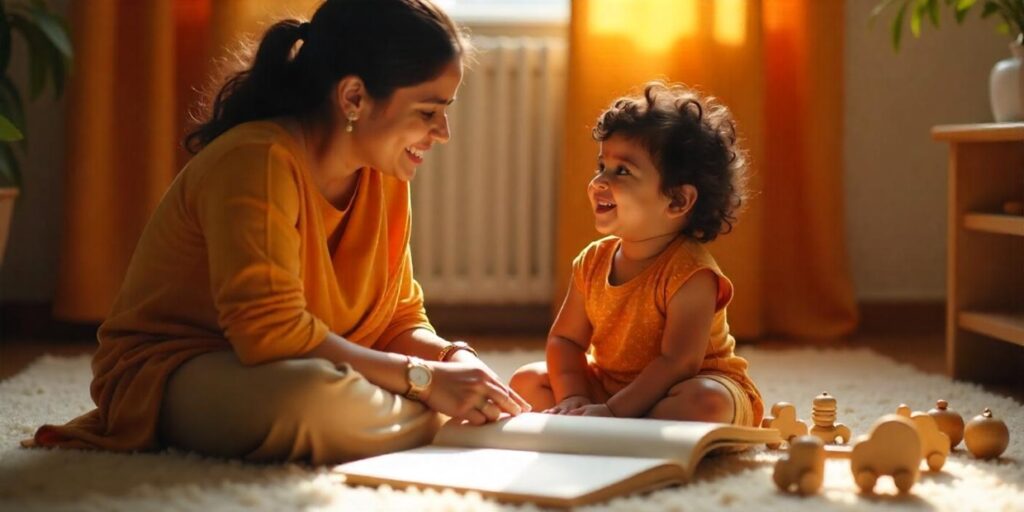
1. Read Aloud Together, Every Day
Even if they’re not reading yet, listening to your voice helps build vocabulary, sentence structure, and a love for stories.
2. Name Things Naturally
Point to everyday items and say their names casually: “This is your blue cup,” “Let’s open the fridge,” “Wow, a red car!” This builds language without forcing it.
3. Let Them Scribble Freely
Before writing letters, children need to build hand strength and coordination. Give them crayons, sand trays, or chalk to just explore.
4. Sing Rhymes and Alphabet Songs
Make it playful. Let them sing with you during bath time or car rides. Music makes memory stick—but let them join in only when they want to.
5. Celebrate Small Wins, Gently
If they recognize the letter ‘A’ in a book or on a signboard, smile and say, “Look at you noticing letters!” That joy matters more than perfection.
A Little Time, A Lot of Trust
Three months after our talk, Meera came back with a beaming smile. Anika had begun recognizing letters on her own. Not because someone drilled her. But because her curiosity kicked in. She asked, “What’s this letter, Amma?” and slowly started collecting her own alphabet treasure chest, one letter at a time.
That’s the magic of trust. When we stop comparing and start observing, we realize every child is learning—even if it doesn’t look like the next child’s learning.
Dear Parent, Take a Deep Breath
If your child is not reciting A to Z yet, it doesn’t mean they’re falling behind. It simply means their focus is elsewhere right now—and that’s okay. Let their growth be a journey, not a checklist.
At Crescentia Sprouts Academy, we are here to hold their hand—and yours—every step of the way. Let’s raise children who love to learn, not just perform.
So tonight, snuggle up with your little one, read a silly story, laugh at the pictures, and forget the alphabet for a while.
The letters will come.
The love must stay.